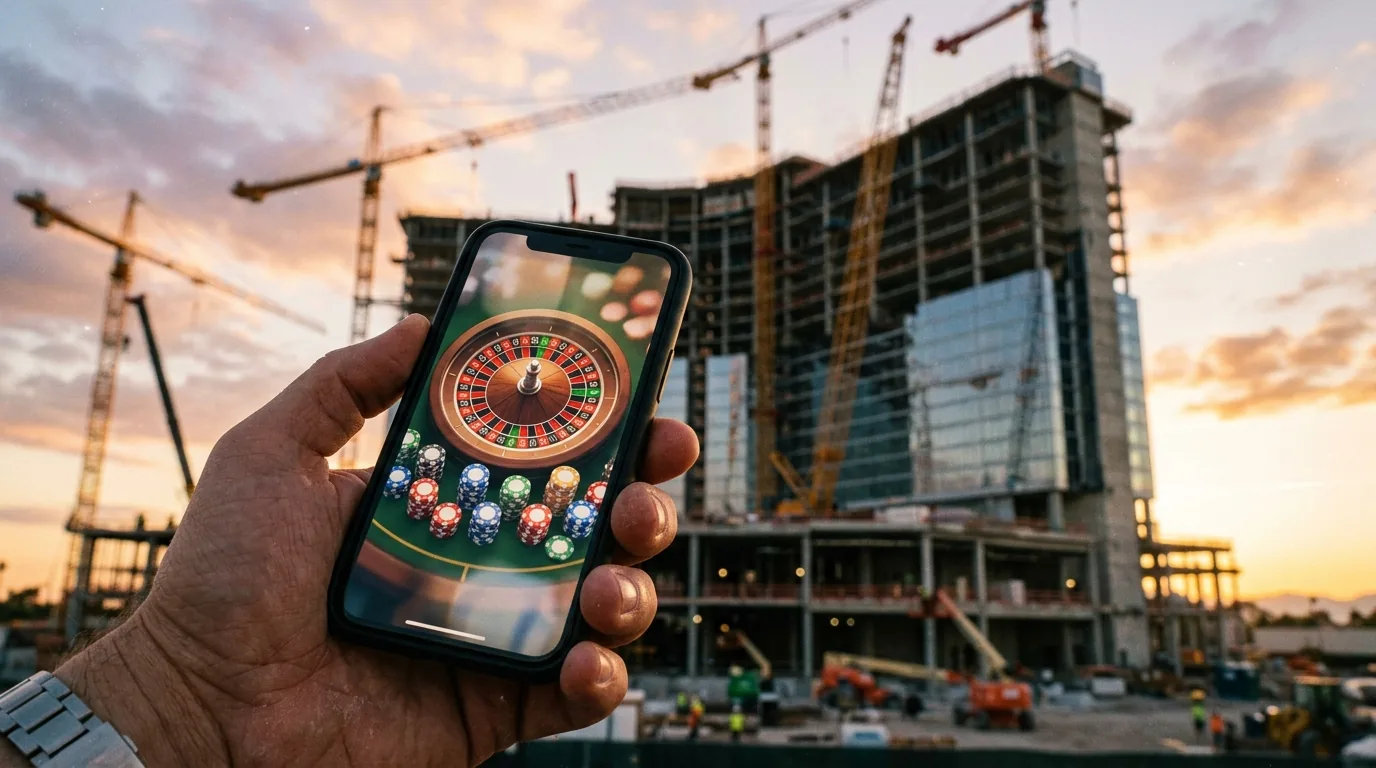
On a strip of reclaimed land off the coast of Ras Al Khaimah, construction crews are still at work on what will become the first casino resort in the United Arab Emirates. In August, Wynn Resorts told investors that Wynn Al Marjan Island will now open in September 2027, a few months later than planned, and that the budget had grown by about $600 million to roughly $5.7 billion. The company blamed about half of the overrun on shipping, insurance and material costs tied to the conflict in the region.
Overruns like that have not slowed the sector down. Big casino money is still moving. Japan broke ground on its first integrated resort in Osaka in April 2025. New York finally handed out three downstate casino licences in December 2025, ending a process that began back in 2013.
The bigger shift, though, is happening on phones rather than building sites. According to H2 Gambling Capital, online gambling generated $293 billion in 2024, or 41% of all gross gaming revenue worldwide. The research firm expects online to account for the majority of the market for the first time in 2029, and to help carry total global gambling revenue past $1 trillion in 2030.
On paper, that makes the digital casino the obvious place to put capital. Look closely at what it takes to build and market one, and a different picture emerges. Getting an online casino licensed, funded, paid and noticed has become slower and more expensive than the growth charts suggest, and in several of the world's biggest markets it is getting harder, not easier.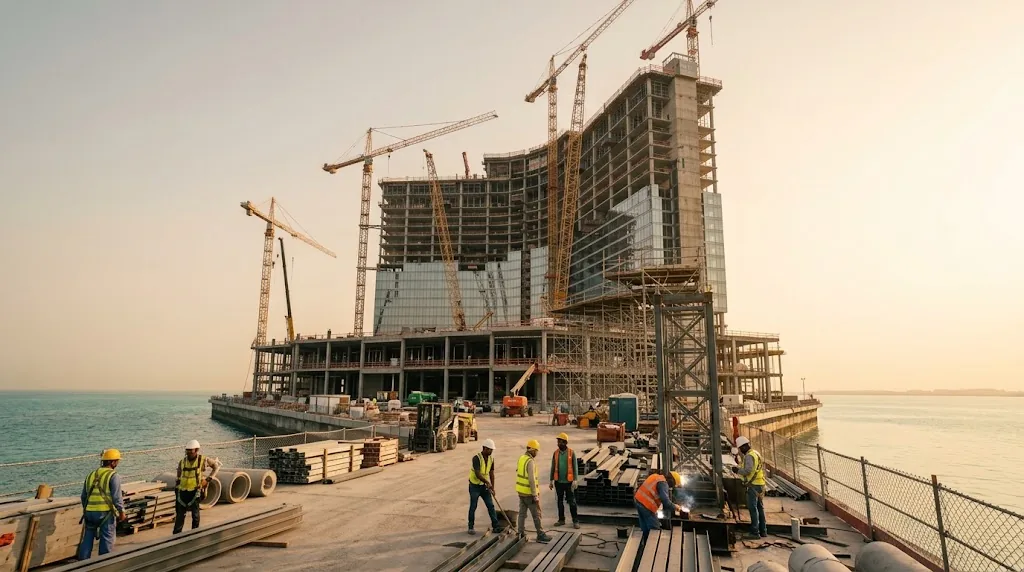
Big money is still betting on bricks and mortar
The integrated resort, a casino wrapped inside hotels, arenas, restaurants and convention space, is enjoying a second life. Most of the new projects are going up in places that never allowed casinos before.
Wynn's case for the UAE rests on geography. In a presentation to analysts last December, the company said it expects the property to produce between $1 billion and $1.66 billion in gaming revenue a year once it matures, and its modelling counts some 2.4 billion people living within a four-hour flight. For now it holds the only casino licence the UAE has issued.
In Japan, the MGM and ORIX consortium is building on Yumeshima, an artificial island in Osaka Bay that also hosted Expo 2025. The resort is priced at around ¥1.27 trillion, or roughly $8.6 billion, and scheduled to open in autumn 2030. MGM chief executive Bill Hornbuckle has told investors he expects it to earn more than $2 billion a year in EBITDA, possibly from the first year.
New York's numbers are just as large. Each of the three downstate winners had to pay a $500 million licence fee and commit at least $500 million in capital spending. The proposals themselves go much further: about $8 billion for Metropolitan Park next to Citi Field, $4 billion for Bally's in the Bronx and $5.5 billion for the Resorts World expansion in Queens. Hard Rock's project and Bally's are both aiming for 2030.
What ties these deals together is scarcity. New York created three licences for the downstate region. Osaka is Japan's only approved site so far. Wynn is alone in the UAE. A limited licence works like a moat, and investors are willing to wait years and absorb cost overruns because nobody can open next door. That protection is precisely what the online side of the business does not have.
Online is where the growth is
The numbers from regulated markets explain why so many founders want in. In the United States, the American Gaming Association's State of the States 2026 report put commercial gaming revenue at a record $78.6 billion for 2025. Online casino revenue jumped 27.6% to $10.73 billion, even though only seven states allowed it. In Pennsylvania and New Jersey, online casinos out-earned the land-based casino floors for the first time.
Brazil, which opened its regulated market on January 1, 2025, moved even faster. The Secretariat of Prizes and Bets reported that licensed operators generated about R$37 billion, roughly $7 billion, in gross gaming revenue in the first year, from 25.2 million customers. The government collected close to R$10 billion in tax on top of about R$2.5 billion in licence fees.
The growth is not limited to the usual suspects. H2 expects gambling revenue in Latin America and the Caribbean to rise from $29 billion in 2024 to $51 billion by 2030, and Africa's to more than double from $14 billion to $31 billion, both driven mainly by online play. Within the online channel, casino games are catching up with sports betting. H2 forecasts online casino revenue of $233 billion in 2030, against $248 billion for online betting, with the two roughly level a year later.
That is the investment thesis in one paragraph. It is also the reason the market has become so crowded.
Building the site is easy. Making it legal and getting paid is not.
Technically, launching an online casino has never been simpler. White-label and turnkey platform providers will rent out a finished product: a site, a cashier, a bonus engine, player management tools and access to thousands of slot and live dealer games through content aggregators. A small team can have something live in weeks.
That accessibility is part of the problem. Thousands of sites now run on similar software and offer the same games from the same studios, often with the same welcome bonus. The product itself rarely sets one casino apart from another. What separates them is everything around it.
Licensing comes first, and it is getting more expensive almost everywhere. Brazil charges R$30 million for a five-year federal authorisation and requires a locally incorporated company. Curaçao, for years the cheapest door into the business, has scrapped its old master-licence system in favour of direct licensing under a new national ordinance, with real anti-money-laundering duties and local substance requirements. Platform supplier SOFTSWISS now tells clients to budget at least €55,000 for a new Curaçao licence. Every additional market means another application, another round of game certification and another tax regime.
Compliance does not stop once the licence arrives. Regulated operators have to verify identities, monitor transactions, run source-of-funds checks on bigger spenders and staff responsible gambling teams. In markets such as Great Britain, affordability checks and stake limits on online slots add further cost and friction to every customer relationship.
Then there are payments, the problem founders tend to underestimate. Banks and card networks treat gambling as high-risk business, which means higher processing fees, rolling reserves and accounts that can be closed with little notice. Britain banned credit card gambling in 2020 and Australia followed for online wagering in 2024. Brazil only allows deposits through approved channels such as Pix and keeps credit cards and crypto out of the licensed market. Operators who turn to crypto-only payments to avoid those hurdles usually find that mainstream banks, app stores and ad platforms close their doors in return.
The marketing wall
For most consumer start-ups, marketing is a budget question. For an online casino it is a legal question first, and the answer keeps getting narrower.
The big ad platforms only accept gambling advertisers that hold a valid local licence, pass a certification process and target countries where such ads are allowed. That rule alone shuts out a large share of the market. For licensed operators, the restrictions now come from governments too. Italy has banned gambling advertising on TV, radio and digital channels since 2018. Spain pushed most betting ads off television in 2020, and Belgium introduced a broad ban in 2023. The Netherlands, which outlawed untargeted gambling ads in July 2023 and shirt sponsorship in July 2025, went further this summer: in June the Dutch government announced plans for a near-total ban on online gambling advertising and on bonuses, including free bets for new customers, while raising the minimum age for high-risk online games to 21.
Brazil may be next. In February, a Senate committee approved a bill that would ban betting and online casino advertising across TV, radio, print, social media and sports sponsorship. Even in markets without bans, the classic weapon of the trade is being blunted. In Great Britain, new rules that took effect in January 2026 capped bonus wagering requirements at ten times the bonus and banned promotions that mix casino and betting products.
With paid channels shrinking, many operators lean on affiliates: review and comparison sites that earn a fee for each depositing player they send, a share of that player's future revenue, or both. Gambling has long been the most lucrative affiliate vertical per customer, which is exactly why it attracted so much aggressive search engine optimisation. Google's crackdown on what it calls site reputation abuse, aimed at casino and other commercial content hosted on high-authority news and media domains, wiped out many of the affiliate-publisher partnerships that had dominated results for terms like "best online casino". At the same time, AI-generated answers at the top of search pages are absorbing clicks that used to flow to review sites.
The result is an acquisition model that is expensive, fragile and heavily dependent on a handful of gatekeepers. New brands find themselves paying more for each first-time depositor, while the operators with recognisable names and loyal customers spend less to keep them. In a market where the games are largely interchangeable, trust and brand recognition have become the real product.
Governments want a bigger cut
A decade ago, regulation was what opened new markets to online casinos. In several of the largest markets today, it is what squeezes their margins.
Britain offers the clearest example. On April 1, 2026, Remote Gaming Duty on online casino revenue nearly doubled from 21% to 40%, and the tax on online sports betting is set to rise from 15% to 25% in April 2027. The Office for Budget Responsibility expects operators to pass around 90% of the increase on to customers through worse odds or smaller payouts, and estimates that the change in behaviour will cut the expected tax take by about a third. Large listed operators have said they hope to offset between a quarter and half of the damage by trimming marketing, promotions and staff. Evoke, the owner of William Hill, is closing 200 betting shops while it works through a strategic review.
Cutting costs has its own risk. Dan Waugh, a partner at the consultancy Regulus Partners, told NEXT.io that if spending cuts drag revenue down, operators may be forced to cut again. "There is that risk of a spiral effect," he said. The Netherlands is the example the industry keeps pointing to: a Dutch tax increase that was supposed to raise about €200 million ended up with lower receipts as unlicensed sites took a bigger share of play.
Brazil is heading in the same direction, only more gradually. Under Complementary Law 224/2025, the tax on licensed operators' gross gaming revenue rose from 12% to 13% this year and is scheduled to reach 14% in 2027 and 15% in 2028. Politics adds another layer of uncertainty. President Lula has pledged to bar recipients of the Bolsa Família welfare programme from gambling, and a bill now sitting in Congress would repeal the regulated framework altogether, all with a general election this month.
For a new entrant, this changes the arithmetic. A business plan written two years ago around a 21% tax in Britain or a 12% tax in Brazil no longer holds. Regulatory risk now has to be priced the way investors price market risk, because in this industry it can move just as fast.
Rivals that play by different rules
The hardest thing for a licensed operator to explain to investors may be this: some of its toughest competitors pay no gambling tax at all.
H2's figures show that offshore operators, meaning sites serving players in markets where they hold no local licence, still took about 55% of global online gambling revenue in 2024. That share has fallen sharply from 73% in 2015, and H2 expects licensed operators to overtake offshore ones in the coming years. But offshore revenue is still growing in absolute terms, and it is gaining ground again in some mature, heavily taxed markets.
Brazil shows how stubborn the problem is. Regulators worked with the telecoms agency Anatel to block more than 25,000 illegal sites in 2025, yet industry estimates still put unlicensed operators at up to half of all betting activity. Unlicensed sites can offer larger bonuses, take crypto and credit cards and skip identity checks, which is the frictionless experience regulators are removing from licensed brands. In Britain, the government gave the Gambling Commission an extra £26 million for enforcement alongside the tax rise, but senior figures at the regulator have openly described an imbalance between its resources and those of the illegal operators it is chasing.
In the United States the competition has taken new shapes. Sweepstakes casinos, which use a dual-currency model to argue they are not gambling, spread across most states before lawmakers caught up. California's ban took effect on January 1, 2026, following similar laws in New Jersey and New York, and several other states have since joined them.
Prediction markets are the newer and larger fight. Platforms such as Kalshi and Polymarket sell event contracts on sports outcomes under federal derivatives oversight, which lets them operate in states where sports betting is illegal and sidestep state licences, taxes and advertising rules. States have responded with lawsuits and cease-and-desist orders, while the Commodity Futures Trading Commission has sued nine states to defend the platforms. DraftKings, FanDuel and Fanatics have all launched prediction products of their own.
For now the battle is about sports, and the prediction market lobby has conceded that contracts on casino games should not be allowed. Online casino operators are watching anyway. The episode has shown how quickly a new legal structure can pull billions of dollars in wagers away from a licensed system that took years to build.
What the next five years look like
Nobody serious is predicting that people will gamble less. If H2's forecasts hold, the global market will be worth more than $1 trillion a year by 2030, and more than half of it will come from screens. The real argument is about who captures that money and how much of it survives tax.
Scale is the first answer most executives give. Bigger groups can spread licensing, compliance and technology costs across many markets, absorb a tax shock in one country with profits from another and keep spending on brand advertising where it is still allowed. In Britain, several operators are already picking up the databases, brands and assets of struggling rivals. Expect more of that across Europe as margins tighten.
The second answer is to sell the shovels rather than dig. Platform providers, game studios and payment and identity verification firms sell to dozens or hundreds of operators at once, and they do not carry the cost of winning each player. For many investors, that end of the industry now looks like the safer way to ride online growth.
For newcomers who still want to build a consumer brand, the playbook has narrowed. Pick one or two markets and hold a proper local licence in each. Secure banking and local payment partners before launch, not after. Budget for compliance as a permanent cost rather than a one-off. And treat retention as the main business, because with acquisition this expensive, keeping a customer is usually far cheaper than finding a new one. Content and search still matter, but only when it comes from people who clearly know the subject, which is precisely what Google's recent updates reward.
On the land-based side, the coming openings will test the scarcity theory. Wynn Al Marjan Island in late 2027, then Osaka and the New York projects around 2030, will show whether destination resorts in new jurisdictions can deliver the returns their backers have promised.
The odds still favour the house. What has changed is what it costs to build one, online or off, and how few new players can afford to try.
