Florida Attorney General James Uthmeier is telling Google, Meta and three other tech companies to stop running sweepstakes casino ads in his state. Reddit, Snap and TikTok got the same letter, with an Oct. 23 deadline to confirm the ads are gone.
In letters he made public Sept. 25, Uthmeier named Stake and three VGW brands, Chumba Casino, LuckyLand and Global Poker, among the sites at issue. Each company was asked to explain how it will keep those ads away from Florida users.
The letters build on lawsuits he filed in August against Stake and VGW, which also named payment companies. His office, he wrote, will pursue "both those who operate and those who facilitate" the sites.
Florida lawmakers have not passed a ban aimed at online sweepstakes casinos. Uthmeier's position is that he doesn't need one, because existing gambling law already covers them.
That approach, going after the businesses around the operators, is where the national fight is heading. Ten states have passed laws aimed squarely at the dual-currency model since 2025, and several reach payment processors, affiliates and geolocation vendors. Oklahoma's, which covers everyone from suppliers to promoters, takes effect Nov. 1.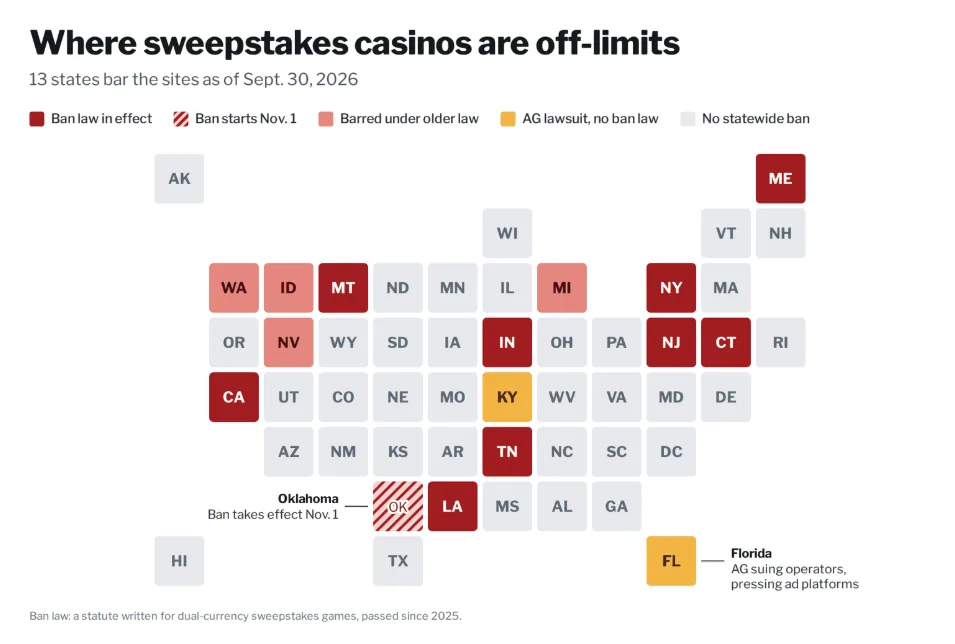
Where the bans stand
Sweepstakes casinos are shut out of 13 states today. Oklahoma makes it 14 on Nov. 1.
Ten of those states passed laws written specifically for the dual-currency model. Here is when each one took hold, newest first.
|
State |
Law |
In effect |
Key detail |
|---|---|---|---|
|
Oklahoma |
SB 1589 |
Nov. 1, 2026 |
Enacted over Gov. Kevin Stitt's veto; felony penalties reach suppliers, affiliates, payment processors and promoters |
|
Louisiana |
HB 883, HB 53 |
Aug. 1, 2026 |
Adds racketeering exposure: up to 50 years and $1 million in fines |
|
Maine |
LD 2007 |
July 14, 2026 |
Signed by Gov. Janet Mills in April; Gambling Control Unit enforces |
|
Indiana |
HB 1052 |
July 1, 2026 |
Civil penalties up to $100,000 |
|
Tennessee |
SB 2136 |
May 22, 2026 |
Took effect on signing; attorney general enforces |
|
California |
AB 831 |
Jan. 1, 2026 |
Liability extends to payment processors and affiliates |
|
New York |
S5935A |
Dec. 5, 2025 |
Fines of $10,000 to $100,000 per violation |
|
Connecticut |
SB 1235 |
Oct. 1, 2025 |
Running a site is a Class D felony |
|
Montana |
SB 555 |
Oct. 1, 2025 |
First state to pass an explicit ban |
|
New Jersey |
A5447 |
Aug. 15, 2025 |
Ban sits alongside licensed real-money online casinos |
Idaho, Michigan, Nevada and Washington keep the sites out under broader gambling laws. Nevada stiffened penalties for all unlicensed operators in 2025, and Michigan regulators have relied on cease-and-desist orders since 2024.
Other states aren't waiting for lawmakers. Kentucky Attorney General Russell Coleman sued VGW in June, and Illinois regulators sent more than 60 cease-and-desist letters in February.
Why states call it gambling
The fight turns on a second currency. Players buy packages of Gold Coins, which can't be cashed out, and get Sweeps Coins as a bonus. Sweeps Coins can be redeemed for cash or gift cards.
Operators say that makes the games a legal promotion, since Sweeps Coins are also handed out free through daily logins and mail-in requests. States increasingly don't buy it.
New York's attorney general found that VGW customers effectively paid about a dollar for each Sweeps Coin, much like buying chips at a casino. That finding sits behind the $8 million settlement VGW reached with the state on Sept. 9 over Chumba Casino, Global Poker and LuckyLand Slots. The company had stopped selling coins in New York after a cease-and-desist letter in June 2025.
Regulators and licensed operators also argue the sites skip the audits and gaming taxes that licensed casinos face. The American Gaming Association, which represents licensed operators, has backed the bans. Tribal gaming interests supported them in California and Oklahoma.
The pushback
The industry has fought nearly every bill, with mixed results. The Social Gaming Leadership Alliance, the operators' main trade group, argues the games are free-to-play entertainment that should be regulated rather than banned. It warned that California's ban could strip $1 billion from the state's economy.
Some governors balked, too. Oklahoma Gov. Kevin Stitt vetoed SB 1589 in May, writing that the state's gaming laws must be "clear, targeted, and fair" and that the bill fell short. Lawmakers overrode him within a week, 34-10 in the Senate and 68-19 in the House.
Louisiana Gov. Jeff Landry vetoed a ban in 2025, saying regulators already had the tools they needed. This May he signed a narrower rewrite, along with the racketeering bill.
Not every tribe is on board either. Several smaller California tribes opposed AB 831, arguing it limited their own economic options.
Operators are also fighting in court. VGW has said it plans to "vigorously defend" itself against Kentucky's lawsuit.
So far, the bans have shrunk the map without emptying the market. Most sweepstakes sites still serve more than 30 states, and new brands kept launching through the summer. Some are testing card-collecting and mystery-box formats in place of the classic two-coin setup, and whether those survive the next round of bills is an open question.
What comes next
The next deadline is Oct. 23, when the five tech companies owe Florida their answers. Google already treats sweepstakes casinos as gambling under its ad rules, a change it made in October 2025 that requires a license most operators don't hold. Uthmeier's letters put the same question to Meta, Reddit, Snap and TikTok.
Oklahoma follows on Nov. 1. Operators have to stop serving the state by then, though the law exempts tribal gaming conducted under federal Indian gaming law.
After that, the fight moves back to statehouses. Florida came close this year: the House passed an amended illegal-gambling bill 82-31 on March 11, but it died March 13 when the Senate didn't take up the changes before adjournment.
Bills in Maryland and Minnesota stalled. A proposal in Washington, D.C., would pair a sweepstakes ban with legal online casinos.
Florida's route doesn't need a new law at all. If the ad platforms comply, operators lose a major way to reach roughly 23 million Floridians, whether or not the lawsuits succeed.
