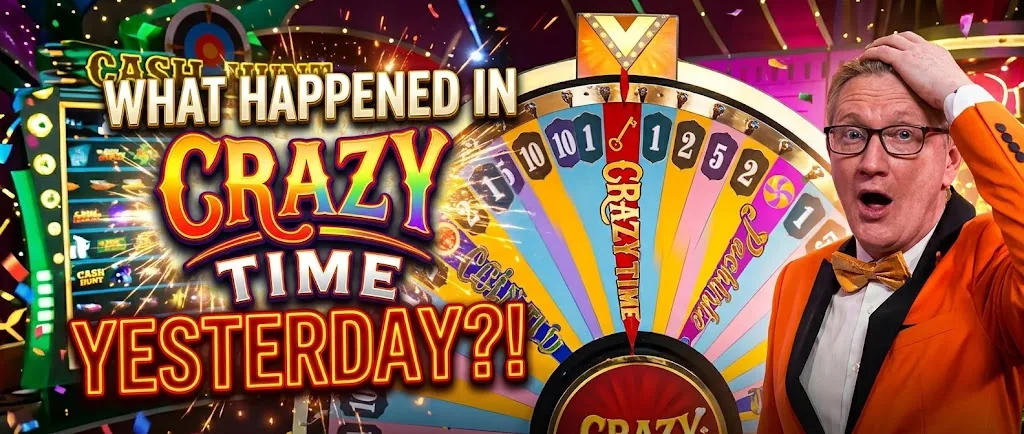
A 32-second Crazy Time clip has revived an old accusation: that Evolution’s wheel is steered by hidden magnets or brakes. Here is what the footage shows, how the game works and who checks it.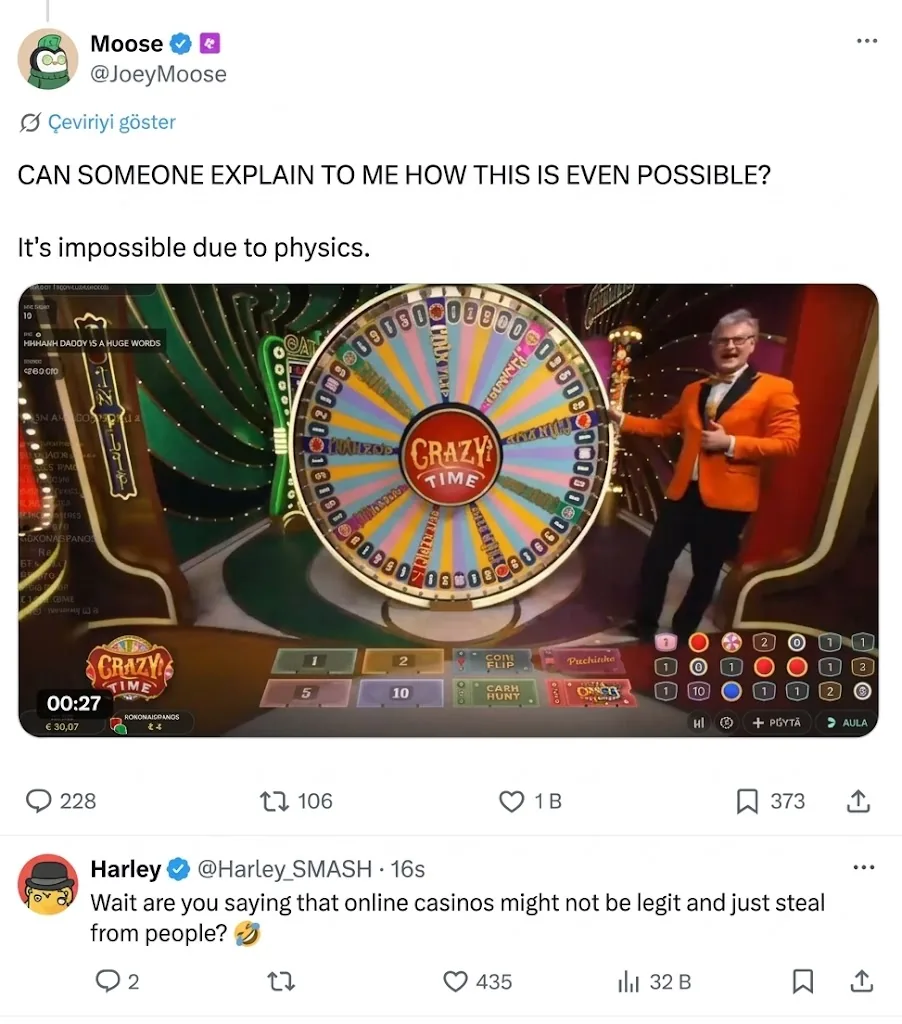
What happened
On November 3, Kick streamer SriouGambles posted a clip of a Crazy Time round he had played at Roobet. He tagged Evolution’s official X account and asked it to “explain what happened.” He also noted that the round was neither canceled nor refunded.
In the recording, the wheel is nearly out of momentum as the 2 reaches the flapper. That was the segment the Top Slot had boosted for the round. The wheel lingers there for several seconds, then slips onto the neighboring 1, one segment short of Coin Flip.
The round settled as a 1, and SriouGambles won nothing. By November 4, the post had passed 280,000 views, according to iGaming Express. Many replies claimed the wheel hides magnets, a brake or a motor, and some players said they had seen similar finishes before.
As the clip spread, SriouGambles said Roobet was not to blame, because Evolution supplies the game to most large casinos. He lists Roobet as a partner on his X profile.
As of November 5, we could find no public explanation of the round from Evolution or Roobet. That leaves two questions open: why the wheel slowed the way it did, and whether anything was wrong with it.
Is there a magnet in the Crazy Time wheel?
The theory is older than this clip. For years, videos and forum threads have pointed to sudden stops or very long spins as proof of hidden brakes, magnets or motors.
We found no regulatory finding or enforcement action showing that a Crazy Time wheel contained such a device. Evolution describes every spin as random and independent of the ones before it.
There is also a mundane explanation for a slow, creeping finish. On a pegged prize wheel, the flapper bends each time a peg passes, and every bend drains energy.
Near the end of a spin, the wheel may lack the energy to clear the next peg. It can then crawl, stall against the peg or rock back a segment.
That does not prove what happened in this round. It shows why one slow finish, seen once on a stream, is weak evidence either way.
The broader accusation, that the wheel avoids boosted segments, can be tested. If it were true, boosted segments would land less often than their share of the 54 slots over thousands of rounds.
SLOTyi’s Crazy Time live tracker logs completed rounds next to their Top Slot results. It compares each segment’s hits with its theoretical frequency over samples of up to 1,000 spins.
Short samples swing widely, so a gap over a few hundred rounds proves nothing on its own. The data describes past spins and cannot predict the next one.
How Crazy Time works
Crazy Time is a live game show that Evolution launched in 2020. A presenter spins a physical money wheel with 54 segments. Players bet on where it will stop during a 15-second betting window.
| Segment | Slots on the wheel | Base payout | Chance per spin |
|---|---|---|---|
| 1 | 21 | 1:1 | 38.89% |
| 2 | 13 | 2:1 | 24.07% |
| 5 | 7 | 5:1 | 12.96% |
| 10 | 4 | 10:1 | 7.41% |
| Coin Flip | 4 | Bonus round | 7.41% |
| Cash Hunt | 2 | Bonus round | 3.70% |
| Pachinko | 2 | Bonus round | 3.70% |
| Crazy Time | 1 | Bonus round | 1.85% |
Bonus segments fill 9 of the 54 slots, so a bonus round lands about once every six spins on average. Before each spin, the two-reel Top Slot can attach a multiplier of up to 50x to one random bet spot. If the wheel stops there, that win is multiplied.
Each bonus round mixes physical and digital parts:
- Coin Flip: red and blue multipliers are revealed, then a launcher flips a physical coin.
- Cash Hunt: 108 hidden multipliers are shuffled on screen and each player picks a target, so wins differ between players.
- Pachinko: the presenter drops a puck down a physical peg wall. A Double pocket doubles the multipliers and triggers another drop, up to 10,000x.
- Crazy Time: a virtual 64-segment wheel with green, blue and yellow flappers, started by the presenter with a button. Double and Triple segments boost the multipliers and trigger respins, up to 20,000x.
The main wheel, the Pachinko wall and the coin are physical. The Top Slot, the bonus multipliers and the Crazy Time bonus wheel run on software. Evolution puts the theoretical RTP between 94.41% and 96.08%, depending on the bet.
Everyone at the same table is settled on the same spin, whichever casino they play through.
Who audits Crazy Time?
Oversight works on three levels: Evolution’s own licenses, the technical standards those licenses impose, and the casino that takes your bet.
Evolution’s licenses
Evolution lists licenses or approvals in more than 30 jurisdictions. They include the Malta Gaming Authority, the UK Gambling Commission, Sweden’s gambling authority, Ontario’s AGCO and state regulators in New Jersey, Pennsylvania and Michigan.
Standards for live studios
In Great Britain, technical standard RTS 17 requires live dealer operations to be fair and open to independent audit. Its guidance calls for casino-grade equipment and staff who monitor its integrity. It also calls for video recording of all dealer activity, access controls, and game logs analyzed for trends.
Licensees must back this with independent assurance from a regulator or a test house. Those recordings and logs are the evidence that could settle a disputed spin.
Testing the software
Under the same British rules, an approved test house must statistically test the random number generator and verify the game math before release. Physical devices such as wheels are exempt from that RNG test and fall under the studio standard instead. Operators must also monitor live game performance, and a test house reviews those checks every year.
Rules for the wheel itself
Some US regulators write rules for the wheel. When Pennsylvania approved Crazy Time in 2024, its Gaming Control Board required a wheel at least five feet across. A spin also had to complete at least three full revolutions to be valid. If the flapper stopped between two segments, the spin was void and the wheel was spun again.
A slow finish on its own was not one of the listed reasons to void a spin.
The casino layer
Each casino holds its own license, and that license decides where complaints go. Roobet, where the viral round was played, is run by Raw Entertainment B.V. under a Curaçao license and restricts players in the US and UK.
Recent enforcement
In July 2026, the UK Gambling Commission announced a £4.75 million settlement with Evolution Malta Holding Limited. Its games had appeared on six unlicensed websites accessible from Great Britain. The regulator called the failings “serious enough for us to consider licence suspension” but credited Evolution with responding quickly.
Evolution said the two operators involved had evaded its restrictions, and it ended both relationships. The case concerned anti-money-laundering and supply-chain controls, not the fairness of game results.
If a round looks wrong
Canadian operator theScore Bet publishes Evolution’s Crazy Time rules. When an error occurs, the round is paused while the presenter alerts a manager. If the problem cannot be fixed on the spot, the round is canceled and stakes are refunded.
Players who dispute a result should note the round details from the game history and keep a screen recording. They should then contact the casino first. If that fails, the next step is the casino’s licensing authority or its approved dispute service.
Until Evolution explains this round, the clip remains an open question rather than proof of rigging.
Crazy Time rigging claims: FAQ
Is Crazy Time rigged?
We found no published regulatory finding that Crazy Time results are manipulated. The main wheel is a physical device spun on camera. In regulated markets, both the studio and the software face independent checks.
Is there a magnet in the Crazy Time wheel?
We found no verified evidence of magnets, brakes or motors in the wheel. Slow, creeping finishes are consistent with a pegged wheel losing its last energy against the flapper.
Who regulates Evolution?
Evolution holds licenses or approvals in more than 30 jurisdictions, including Malta, Great Britain, Sweden, Ontario and several US states. The casino you play at is licensed separately.
What is Crazy Time’s RTP?
Evolution lists a theoretical RTP of 94.41% to 96.08%, depending on the bet. RTP is a long-run average, not a forecast for one session.
What happens if the wheel malfunctions?
The round is paused while a manager checks the problem. If it cannot be fixed immediately, the round is canceled and bets are refunded.
18+ only. Every Crazy Time bet carries a house edge. Play only where it is legal for you, with a licensed operator, and set a budget before you start.


