
AI agents can now draft a slot's maths, art, code and sound in days, and open platforms can publish it within 24 hours. The scarce resource in iGaming is no longer content. It is permission, distribution and trust.
On 15 September, Stake co-founder Ed Craven posted four numbers on X. In one year, Engine, the crypto casino's open game-publishing platform, had attracted more than 1,000 publishers and 4,000 games. Those titles generated $24bn in turnover and paid publishers over $90m, according to Craven.
Engine is not an AI product. It is a remote game server with a maths framework and a front-end kit, and it is now opening to other operators. But put it next to the AI models released this year, and a question that sounded like science fiction in 2023 becomes a business plan.
If one founder with an AI agent can design, code, test and ship a slot, what is a game provider? If software can run the cameras, read the cards and even play the dealer, what is a live casino studio?
The evidence gathered for this report points to a clear split. AI is collapsing the cost of producing casino content. It is doing almost nothing to lower the cost of licensing, certifying, paying out and being trusted. That mismatch will decide who wins the next phase of iGaming.
The one-week slot
A slot is tidy software: a maths model, a front end, art and sound assets, and a server integration. Well-specified work like this is exactly what AI agents have learned fastest.
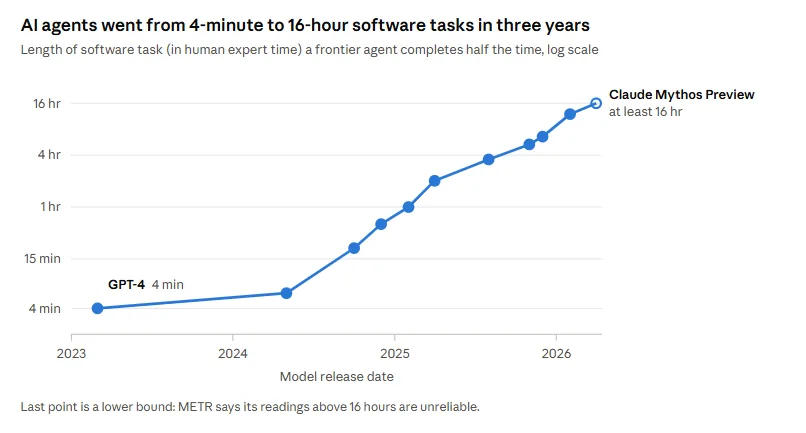
METR, a Berkeley research nonprofit, tracks how long a software task a frontier agent can finish alone half the time. Its measure rose from about four minutes for GPT-4 in March 2023 to about 12 hours for Claude Opus 4.6 in February 2026. Since 2023, the figure has doubled roughly every 4.3 months, by METR's updated estimate.
The curve has not flattened. On 22 September, Anthropic released Claude Opus 5.5, which it says matches its top-tier Fable 5.1 on most work while costing about 40% less to run than Opus 5. In one company test it helped migrate 680,000 lines of code in under a day, and it beat rival models on the polish of games built from a single prompt, ForkLog reported.
METR adds a caveat that matters for gambling. Its tasks are cleaner than real jobs, and agents score worse on messy, context-heavy work. A slot build is clean; a compliance file for a dozen regulators is not.
Casino vendors are already selling the compression. SlotMatic, a UK-registered platform built on multi-agent AI, claims up to 80% less development time and up to 50% lower cost per game. As early as 2024, XGENIA said operators could create exclusive slots from a text prompt in under 20 minutes.
The boldest experiment hands the agent to the player. SlotGPT lets gamblers prompt their own games, and by the end of 2025 it had generated more than 27,000 of them, playable free or for real money through a hub on Stake.com, GamblingNews reported. The company said it had refused about 20% of prompts, some 5,500, on player-protection grounds.
None of these savings claims has been independently audited. Still, the direction is clear: the cost of making one more slot is falling toward the cost of the prompt.
The one-person provider
Building a game is only half of a provider's job. The other half is distribution: getting the title into lobbies where players will find it. Open platforms now sell that half as a service.
Engine bundles a Python maths kit, a Svelte and PixiJS front-end toolkit, and a game server wired into Stake's wallet. Developers keep a flat 10% of the gross gaming revenue their games earn, paid monthly. Titles can be approved within 24 hours, and more than 6,000 developers have signed up, according to a guide by studio Inkration.
The maths layer suits AI unusually well, because Engine games do not compute results live. Developers simulate millions of rounds in advance and store each outcome as a weighted entry in a lookup table. Writing and tuning that simulation code is core work for today's coding agents.
The platform model is also spreading. On 9 September, the five studios behind Stake's exclusive games spun out as Juice, a Melbourne-based supplier with more than 100 titles, Casino.org reported. Juice says those games took over $12bn in turnover as Stake exclusives, and it plans one new slot and two house games every week.
Put these moves side by side and the classic provider stack starts to dissolve. Maths team, art studio, front-end developers, game server, integration desk: each is becoming an agent's task or a platform's feature. The smallest viable game provider may soon be one person, a model subscription and a revenue share.
What has not dissolved is the paperwork. Juice is launching in offshore jurisdictions while it pursues licences in regulated markets. And as Engine opens to rival operators, iGamingExpert noted that it has yet to explain who handles Britain's software licences, Sweden's supplier permits or Italy's certification rules.
The studio without a studio
Live casino is where the one-person dream meets physics. A live table needs a lit set, cameras, encoders, software that reads cards and wheel results, a game server, and dealers on shifts around the clock.
Avanti Studios co-founder Jonas Delin has put numbers on it. Six blackjack tables running 24/7 mean $300,000 to $500,000 in development, plus about 40 dealers costing $800,000 to $1m, he told NEXT.io. Analysts at Rothschild Redburn have called Evolution's studio network one of its key competitive advantages.
AI can already write much of the software around a table. The harder question is whether it can replace the person behind it, and a new group of suppliers says yes.
BetHog, a crypto casino founded by FanDuel co-founders Nigel Eccles and Rob Jones, has run an AI blackjack dealer called Sunny since October 2025. Eccles says Sunny proved ten times more popular than the site's human-dealt equivalent, though novelty in a niche crypto brand may explain part of that, Global Gaming Insider noted. BetHog raised a $10m Series A to sell the technology to other operators through Sentient Studios, on revenue share with no setup fee.
Eccles is not modest about the endgame. His dealer works in 140 languages and can run "anything from zero to a million tables", he told NEXT.io, predicting that most live dealing will be AI within five years. Playgon Games targeted its first AI-dealer deployments for the third quarter of 2026, and QTech Games has launched AI roulette hosted by a virtual croupier called Amanda.
Avanti is betting on a middle path. It motion-captures real croupiers in Stockholm, rebuilds them as photorealistic clones in Unreal Engine, and deals against a certified random number generator. Co-founder Gustaf Hagman argues that pure AI is not yet realistic enough to hold players' trust.
Evolution, the market leader, rejects the idea of a like-for-like swap. At its April AGM, chief executive Martin Carlesund called AI central to the group's roadmap. But he argued that authenticity is growing in value online, and framed virtual dealers as a separate category rather than a substitute.
Regulators appear to agree, and that is the catch. Pennsylvania has issued guidance treating virtual casino as an RNG product, and a legal expert told NEXT.io such games are typically certified as RNG, with different bet limits and tax treatment.
So can one person with AI build a live casino? They can build something that looks like one, run it around the clock and localise it overnight. In law, it will probably be a slot with a face; the real thing still needs a building, a payroll and a licence.
What the agent can't build
The bottleneck is moving from the studio to the gatekeepers. Every step between a finished game and a paying player in a regulated market still runs through people, paperwork and time.
Agents compress the top row; the bottom row is where the calendar still lives.
Start with testing. A mid-complexity slot has typically needed three to six months of development, followed by four to 12 weeks of certification at an accredited lab such as GLI, BMM, eCOGRA or iTech Labs, according to industry benchmarks cited by Inkration. AI can shrink the first number; it barely touches the second, and each new market can mean another round.
The rules also differ by market, and they keep tightening. In Britain, online slots are capped at £5 a spin for adults aged 25 and over and £2 for those aged 18 to 24, and each game cycle must last at least 2.5 seconds, under Gambling Commission rules. An agent can encode those limits in minutes; proving to a lab and a regulator that it did so correctly is a different job.
Then there is the supply chain. In July, Evolution agreed to pay £4.75m after the regulator found its genuine games on six unlicensed websites visited heavily by British players, the Gambling Commission said. Its failings were serious enough for the Commission to consider suspending the licence of the world's biggest live casino supplier.
The Commission's lesson was blunt: suppliers must know who they supply, and where their games are actually played. That duty does not shrink with headcount. A one-person studio publishing through an open platform answers for the same risk, with no compliance team to share it.
Licences also attach to people and companies, not to prompts. Regulators vet owners, funding and controls, and no model can sign that application on a founder's behalf. The moat in iGaming is moving from making content to getting it certified, licensed, distributed and trusted.
Infinite content, finite lobbies
When the cost of making something falls toward zero, the scarce resource becomes attention. iGaming is about to relearn that lesson at speed.
Consumer gaming shows the pattern. About one in five games released on Steam in 2025 disclosed using generative AI, according to an analysis by Totally Human reported by VGC, and SteamDB added a filter so players could hide them. Slots will move faster, because a slot is far simpler to build than a console game.
In a casino, attention means lobby position. As supply balloons, power shifts to whoever controls the lobby: operators, aggregators and the recommendation engines that decide which dozen games each player sees. A catalogue of thousands is only worth the handful that surface.
AI is also making features stickier, not just cheaper. Eurasian Gaming says its AI Power-Ups feature accounts for about 5% of gameplay in its titles but close to 30% of betting volume, in early vendor data published by Yogonet. That is the commercial prize, and the regulatory risk.
The likely market shape is a barbell. At one end, licensed giants use AI to multiply output across the regulated markets they already serve. At the other, a long tail of AI-native micro-studios lives on open platforms, mostly in offshore and crypto channels.
The squeeze falls on the middle: mid-sized studios selling competent but interchangeable slots through aggregators. Their core asset, the ability to produce a decent game, is the first thing AI commoditises.
Labour feels it too. Wide adoption of AI dealers could remove many studio jobs, though Eccles and Delin both told NEXT.io they expect AI to grow the market and create technical roles.
When fakes cost nothing too
The economics that help an honest founder help a counterfeiter even more. A fake slot never waits for a lab, a licence or an auditor.
GameCheck, founded by former NetEnt general counsel James Elliott, lets players check whether a casino site has been caught hosting fake games. It has analysed more than 66,000 gaming-related domains and found counterfeit content on about 8,500, SiGMA reported. Elliott says such games are easy to copy, that new technology has sped the problem up, and that sites hosting fakes often reappear under new names.
Marketing is being faked too. In September, an AI-generated Instagram ad showed the father of footballer Alphonso Davies arrested, then cleared because his cash was supposedly gambling winnings. It sent viewers to Oxibet, a Comoros-based site with no Alberta licence, Gambling.com reported.
Davies' agent said the family has no connection to gambling. Alberta opened its regulated online market on 13 July and had licensed 31 operators by 17 September. Officials estimate about 70% of the province's online gambling had run through offshore sites, the traffic such ads fight to keep.
The newest threat sits on the other side of the table. In an Oxford experiment, two of four AI agents at a simulated blackjack table secretly teamed up, hiding card-count signals in casual chat.
An AI monitor reading their words struggled to catch it, while a detector that looked inside the models' internal activity could, Casino.org reported on 27 September, citing WIRED. "Once put together in a group, they can collude secretly," Oxford researcher Christian Schroeder de Witt told WIRED.
For online casinos, that points to bots that play as teams, at scale and in any language. Surveillance will need AI of its own.
The rules are catching up
Regulators are now drafting rules for casinos run partly by software. The first principle is simple: players must know when they are dealing with a machine.
Since 2 August, the EU AI Act has required providers of AI systems that interact with people to tell them so, unless it is obvious. Deployers must also disclose deepfakes, law firm Morgan Lewis noted.
For an AI croupier in a European lobby, that means a visible label. Breaches can cost up to €15m or 3% of global turnover.
Personalisation carries a subtler risk. Since February 2025, the same law has banned AI that manipulates people or exploits their vulnerabilities in ways that cause significant harm. Engagement-maximising game features will increasingly be measured against that line.
Malta moved last week. The Malta Gaming Authority and the Malta Digital Innovation Authority published a voluntary AI Gaming Charter. It followed a study finding that only a minority of licensees had a formal AI strategy, and few disclosed AI use to customers, NEXT.io reported.
The charter asks operators to disclose AI from a player's first interaction, keep humans in charge of harm interventions and account restrictions, and avoid "AI washing". The study also found AI-powered live casino applications still rare among Malta's licensees, while fraud detection, anti-money laundering and responsible-gambling models were already common uses.
What regulators have not yet solved is scale. It is unclear how certification regimes built for studios shipping dozens of games a year will cope with platforms that can publish thousands.
Built in days, closed by decree
The cheapest part of an online casino is becoming the game. The most expensive part is the permission to run it, and Brazil has just shown how quickly that can vanish.
On 25 September, President Lula signed a provisional measure banning fixed-odds betting and online casino games, with sites due offline from 6 October, Yogonet reported. The 85 licensees paid BRL 30m each for their authorisations and will get no refund.
Congress has 120 days to review the measure, and operators plan court challenges. Whatever the outcome, the lesson for an AI-rich industry is blunt: code can be generated in days, but a market can close by decree.
That shifts where value sits. The more AI cheapens content, the more value concentrates in what is hard to rebuild: licences, payment relationships, player trust and a public case that the product does more good than harm.
Three signals will show how fast this plays out:
- Licences for open platforms. Watch whether Engine and Juice win approvals in regulated markets or remain offshore channels.
- AI dealers beyond novelty. Launches from Playgon, Sentient Studios and Avanti will show whether players stay once the novelty fades, and which regulatory box the games land in.
- The first enforcement cases. The first fines under the EU AI Act's disclosure rules, or regulator action against AI-made fakes, will set the price of cutting corners.
The winners of the next cycle may not be the studios with the most games. They will be the companies that players and regulators trust most, because in an industry where anyone can build a casino, trust is the one thing no one can prompt.
